A real place, your device and the right persona. Put the scene together where it is convenient. Keep it ready for the next presentation.
What is ready, and what is still being proved
The new signed Mac Preview is installed and opens with existing work intact. Its starter portrait chooser and card editor have been checked, and Apple’s Production scene schema is deployed. Mac upload has succeeded; paired editable-scene sync is still unverified. This implementation is included in the signed and notarized Mac Preview 4. iOS 2.1.0 (3) is available for internal maintainer testing through TestFlight. Public App Store review remains pending. See the current evidence.
PREPARE ONCE, USE DELIBERATELY
A small journey, with clear edges.
01 · IPHONE OR IPAD
Make a scene
Open Tools → Scenes. Choose a photo, use the camera or start with a supplied picture. Set the background crop, device position and optional artwork.
02 · YOUR LIBRARY
Keep an editable copy
Save on this device. Opt into personal iCloud sync for the same Apple Account, or explicitly export a scene file. The photo inbox is another source of pictures.
03 · MAC
Present when ready
Open the saved scene in Present a device, choose a local video source and present in a window or full screen. The meeting app decides what to share.
The mobile device frame prepares a layout for later Mac video. It does not remotely operate another app or stream the phone into a scene by itself. Selected-photo handoff remains a separate, smaller transfer.
Job
Best surface
Keep separate
Prepare a presentation
Mobile Scenes; Mac scene editor
Its own background, crop and placed artwork
Present live
A Mac presentation window and small contextual controls
Local device capture, control placement and meeting sharing
Make a wallpaper
Mobile Wallpapers → Save to Photos or Share; Apple’s picker finishes the job
Independent crop and saved project; no automatic installation
Speak, listen or annotate
The existing Dictate, Read aloud and Mark up tools
Their own inputs, recovery and export; no scene setup required
Two mobile tabs remain: Tools and Saved. Home Screen quick actions open Capture for scene or Dictate. Camera and microphone permissions remain native; opening Dictate does not start recording.
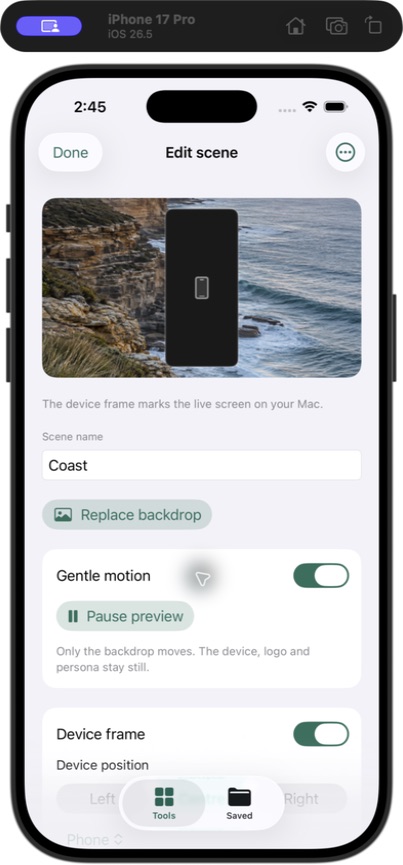
Turn on Gentle motion for a slow zoom of your own photograph. The new ambient starters move only their cloud or leaf details. Your device, logo and persona stay still. Mac presentation controls include Pause/Play; the iPhone scene editor has a separate Pause preview button. Cropping and exported images stay still.
In the Mac version intended for direct download, open More beside the presentation buttons, then choose Use as animated desktop. This applies a still first, then runs a separate desktop layer while Workbench is open. Pause reveals the still; Stop or Quit removes the layer. Ending a presentation leaves this separate desktop session alone.
Included in the signed and notarized Mac Preview 4. No automatic login restart, video downloads or continuously animated iPhone Home Screen. Low Power Mode, Reduce Motion, high temperature and hidden previews suppress motion. iPhone/iPad wallpaper export remains a still; Apple offers Spatial Scene or Live Photo effects where eligible.
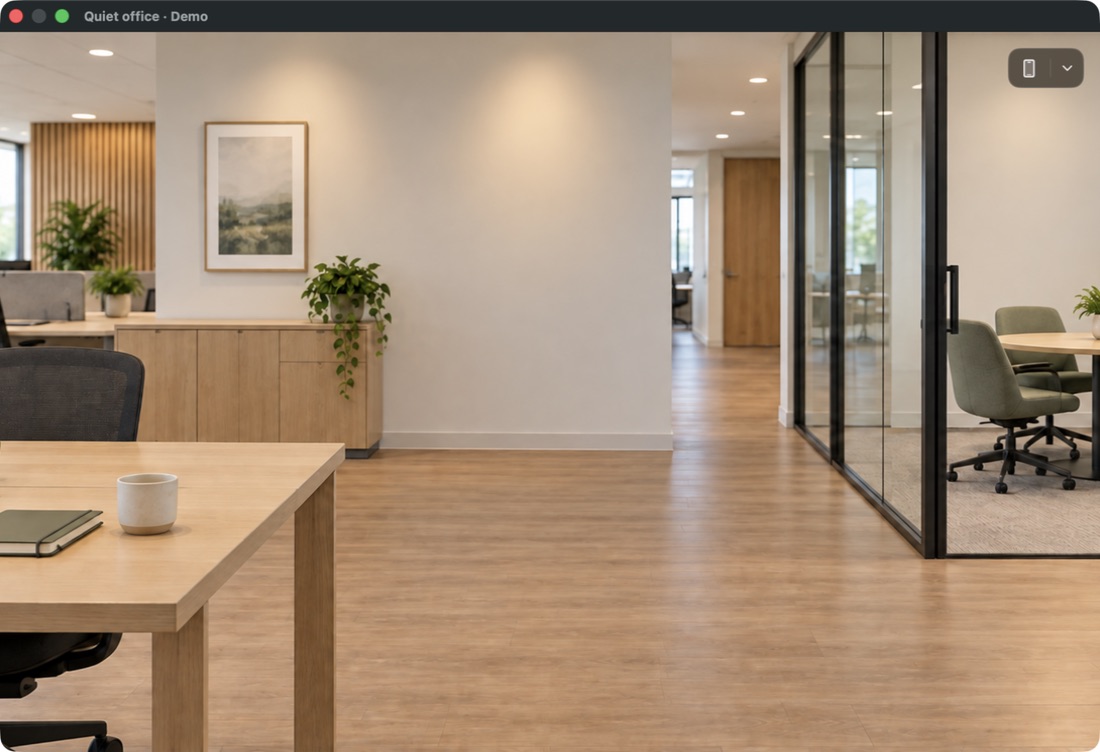
Actual native Mac capture. An isolated test host uses the production scene renderer and bundled office artwork. This still capture cannot demonstrate animation. No device capture or cloud sync was active.Actual iPhone Simulator capture. Coast scene, iOS 26.5. Pause/Play and still crop controls were checked; this is not an installed physical-phone release.
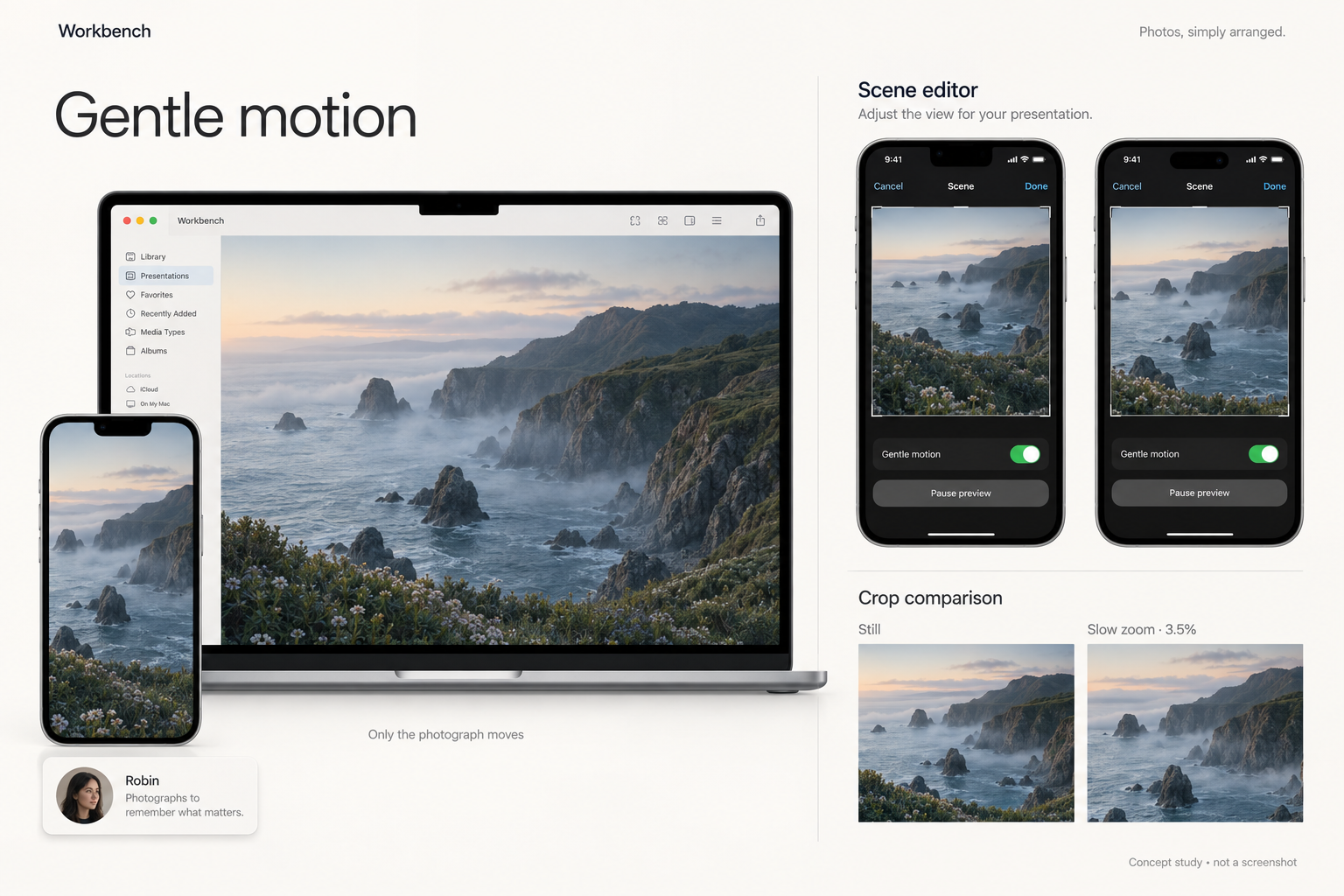
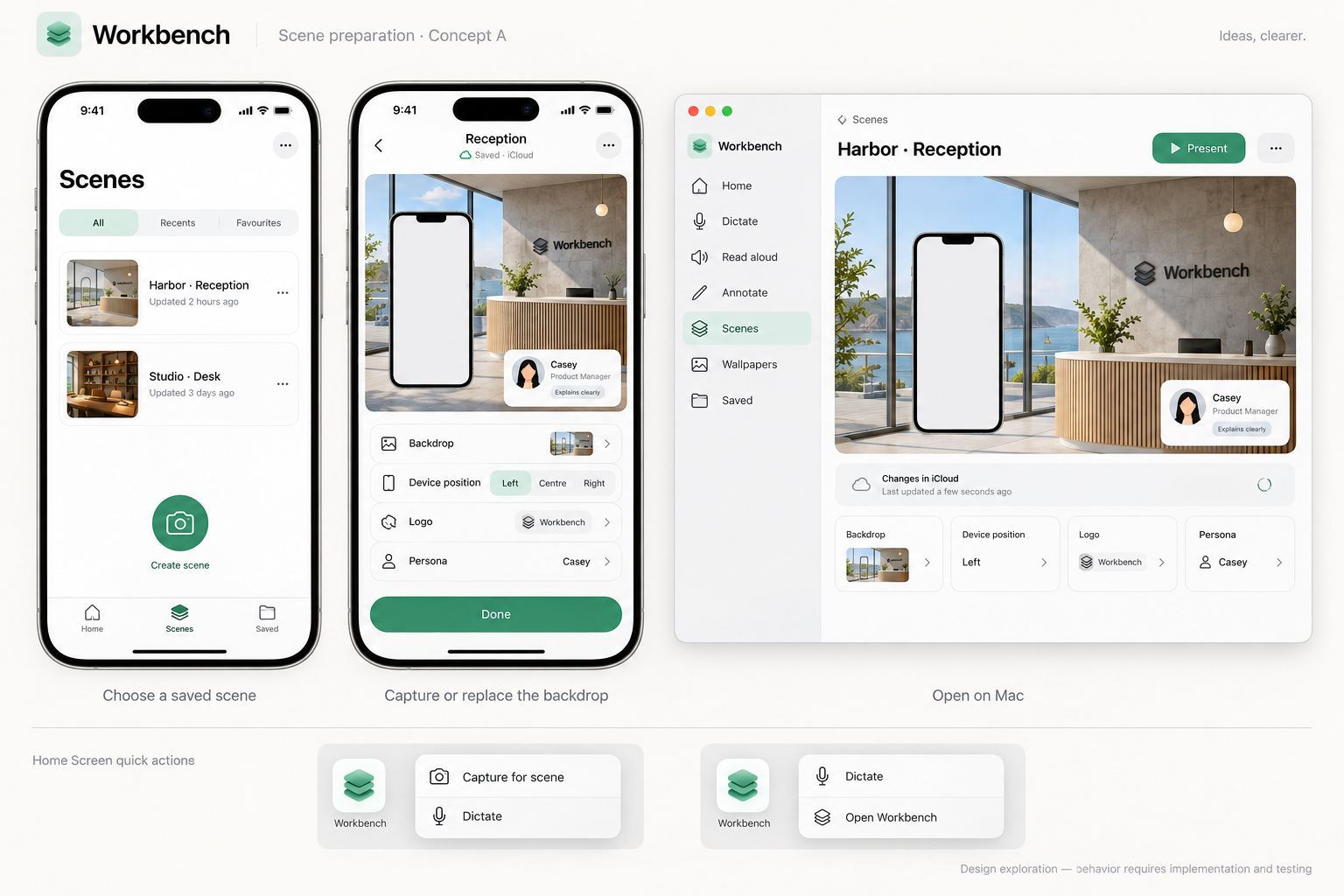
See the motion study and implementation decisionsGenerated concept, not a screenshot. We kept the restrained photo treatment. Invented sidebar categories, decorative cards and simulated wallpaper installation did not become requirements.
A .workbenchscene file carries the layout and source images without iCloud. Import creates a separate scene. Photo arrivals feed the library by copying selected pictures; they do not control a scene.
While Workbench is active: enabled scene sync groups local edits after a short pause. Going into the background stops scheduled and active transfers; saved work waits for the next foreground refresh. If a transfer fails, return to the app or choose Refresh to retry. It does not keep retrying in the background.
Changes preserve your choices
Competing edits keep both versions for review. A late upload receipt cannot replace a newer local edit. Removing a scene hides its record and retains original assets for recovery; it does not delete the source photo.
Changing Apple Accounts stops the existing sync relationship until you deliberately reconnect. Turning sync off keeps downloaded work. Corrupt or newer library formats pause writes rather than reset the library.
Presentations stay predictable
Starting a presentation freezes its scene. A later edit or cloud arrival cannot rearrange the live view. Placed persona artwork is an owned copy, so changing its library card does not silently change the scene.
Old mobile compositions remain recoverable with their original layers, caption and editable ink. Converting one creates a new scene; its landscape preview can differ from the original wallpaper or collage.
The implementation boundary
SceneSyncKit supplies a versioned local manifest, content-hashed image assets, portable packages and revision merging to both native apps. A separate CloudKit adapter uses CKSyncEngine with its own automatic scheduling disabled. Workbench groups committed local edits after 800 ms without another edit; a foreground cycle checks the account, fetches and sends saved work, then persists receipts and engine state. Unchanged saves and receipts cannot start an upload loop. The 800 ms delay is local scheduling, not an arrival-time promise.
Scenes and photos use separate zones and checkpoints in the same private container. There is no team-sharing service, public scene link or background-arrival guarantee. Public-database role permissions are not the access model for this private library. Apple’s CloudKit design guide · Exact store, recovery and acceptance contract.
PREPARED ARTWORK, SMALL LIVE CONTROLS
Give the persona a place in the scene.
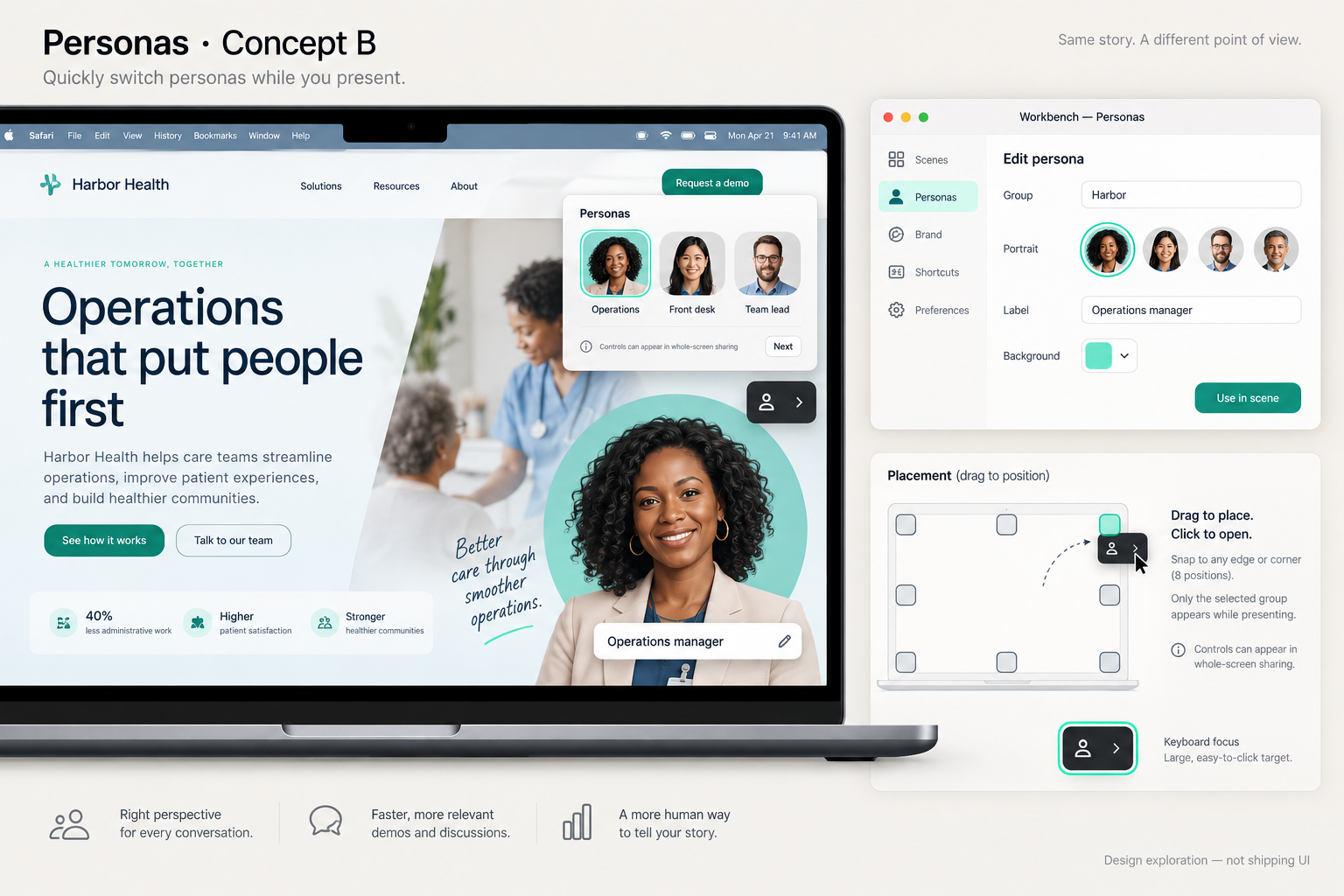
Import a finished transparent card or choose one of eight fictional starter portraits. Edit the suggested role label and card background with native controls. Prepare groups before presenting; live controls switch among prepared people without exposing unrelated group names.
On Mac, a persona can also float above a browser. Its artwork lock is separate from its controls. Named positions provide an alternative to dragging; drag guides show the eight available positions and emphasize the nearest target. A whole-screen share can include separate controls and overlays. Add the persona to the scene when sharing only that window.
RUNNING APP · IPHONE SIMULATOR
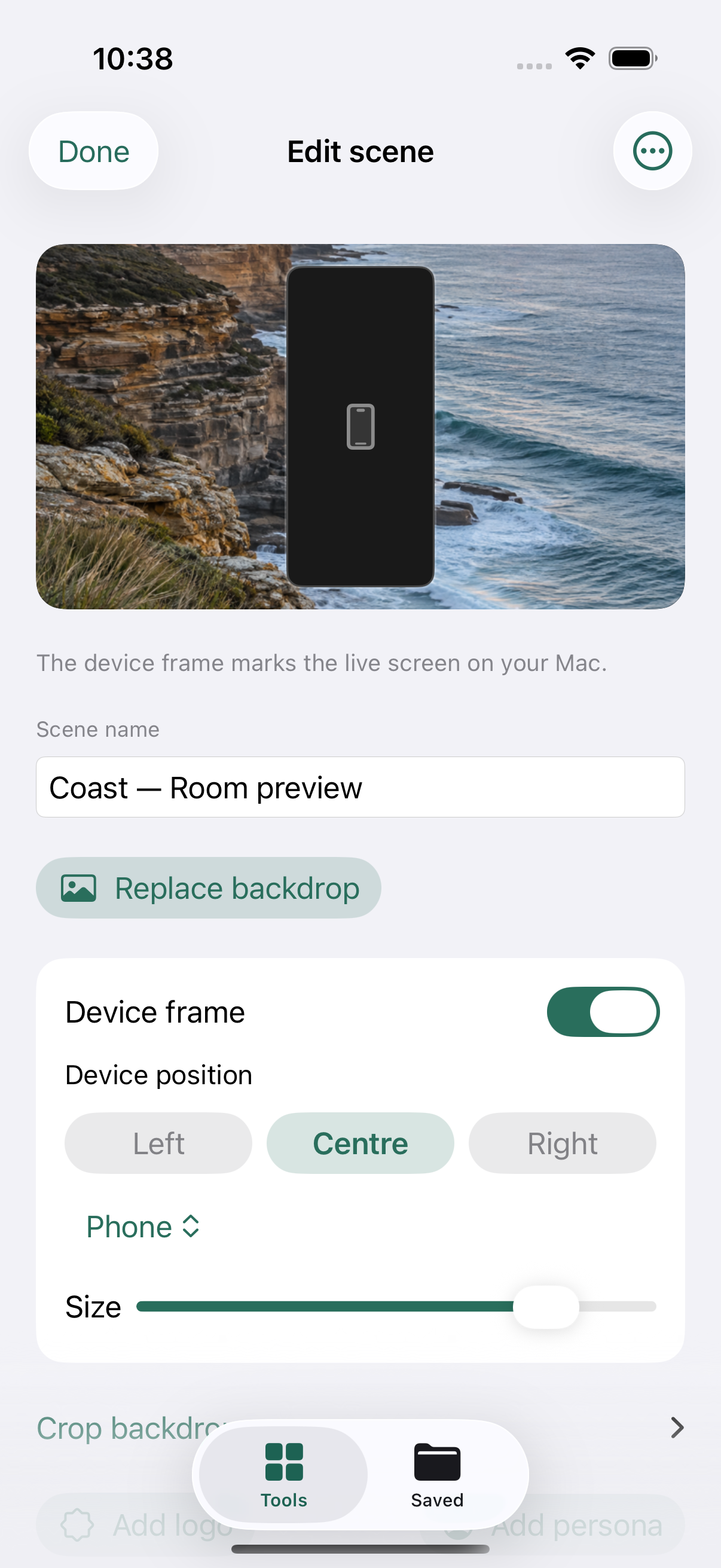
The scene stays editable.
This is the native app after saving and reopening a scene in an isolated iPhone simulator test. The supplied Coast picture and sample title are test content. The same test caught a cropped image intercepting taps on the name field; constraining its hit area fixed the interaction. This capture verifies editing and persistence, not cloud arrival. See the same native editor on iPad.
DESIGN STUDIES · NOT PRODUCT SCREENSHOTS
Useful direction. Questioned details.
Concept A — prepare here, present there. Adopted the connected journey and ordinary editing controls. Rejected the extra navigation, speculative filters and any implication that a cloud icon proves instant arrival. Tools and Saved remain the two mobile tabs.Concept B — prepare the group, simplify the moment. Adopted editable labels, card colours and deliberate positioning. Rejected a new Brand sidebar, oversized artwork as a universal default and editing whole groups during a presentation. Generated controls and copy are design hypotheses.
These boards are generated illustrations. Native screenshots and receiver observations are separate evidence, not interchangeable with a concept or code review.
Voice has its own activation and platform constraints. It does not become a scene-only feature.
This is a review of official documentation and supplied design evidence, not a hands-on competitor benchmark. iCloud Drive remains a credible alternative for a Files-first product; no comparative latency result is claimed. An operated backend is deferred until a real team or cross-platform job requires it.
CONTINUE IN THE BROWSER
Use your personas beyond the scene.
The Mac source preview can prepare several floating persona cards for a browser or desktop demonstration. Each set has its own layout and one small click menu. Starting a device scene pauses that independent session; return to it explicitly when you move back to other apps. Prepare multiple overlays →
Before showing a real phone:Connection and audio routes explains USB, Apple’s apps, Teams/Zoom audio and managed-Mac recovery. Workbench’s scene preview is video only.
EVIDENCE · 15 SEPTEMBER 2026
The next proof is a real paired scene.
Area
Observed
Still pending
Mac preparation and upload
The signed app preserves existing work. Starter portraits, card editing and prepared-role switching were checked. A synthetic scene with a Site manager persona automatically uploaded after editing, without manual refresh, with a matching revision receipt.
Paired editable-scene transfer, live device video and a receiving meeting participant.
Editable scene file
Mac export/import retained all three assets and received cloud receipts. On iPad Simulator, a synthetic Mac copy opened through Files, preserved an edited name and device position after save/reopen, exported to Files and reopened through Workbench. Its images and persona remained intact.
Physical mobile file exchange and interrupted or malformed-file recovery. The Simulator test used cloud disabled.
Older composition recovery
Native Mac controls imported, edited and exported a synthetic mobile composition. On iPad Simulator, that exact file opened, its mobile original was recovered and renamed, and both separate items survived relaunch. All four original images, caption, crop and drawing data survived. The edited Mac scene stayed intact. Source: da4f0f4.
The Mac used an isolated StageKit host; mobile used the full app with cloud disabled. Mobile Files-picker browsing, physical transfer, every-layer editing and iCloud delivery need separate checks. Preserved data does not establish full preview parity.
Presentation stays fixed
A running windowed still presentation retained its title, backdrop and persona while saved preparation changed. End and restart picked up the new preparation. Eight named control positions were available; Top left, dragging to Bottom right, retained placement and click/keyboard controls were checked.
This used the same isolated native Mac host with device capture off and cloud unavailable. Live video, incoming sync, a meeting receiver, fullscreen, all drag targets and guide behavior during drag remain separate checks.
Preservation and sync rules
65 native Mac checks passed with 2,001 assertions. The integrated 73 photo/scene tests passed. A separate strict Swift 6 run passed 48 scene tests, including 26 lifecycle tests.
Synthetic checks do not replace paired-device or failure-recovery tests.
iPhone scene preparation
A synthetic Coast scene saved its edited name, left device position and yellow Site manager card. It reopened intact after closing the app and a cold camera launch/cancel, with phone cloud sync off.
This proves local persistence without cloud sync. Network remained on; airplane-mode operation and paired reception are separate checks.
Native quick actions
Cold and warm Dictate preserved the draft without recording. Warm and cold Capture for scene reached the native camera; dismissing Apple's unavailable-camera alert and cancelling returned safely to Scenes.
At 7e45213, all eight expanded positions kept Position and End reachable in an isolated native Mac host. The compact tile dragged to Left centre and reopened by keyboard. Full-screen transition, Escape collapse and End returned safely to Scenes.
One display and a synthetic still. Every drag target, mid-drag guides, VoiceOver, live capture, audience view and the signed app remain separate checks.
Quick action with unsaved edits
At 7e45213, the genuine Home Screen Dictate action preserved an invalid scene draft in iPad Simulator. Correcting its name saved it, opened Dictate once without recording, and retained the scene through relaunch. The native result records one passed test, zero failures.
Xcode cleanup was interrupted after the test passed. No physical phone, Capture for scene, storage failure, remote conflict or speech-quality result is claimed.
Speech preparation
A readiness regression prompted a bounded recheck and clearer diagnostics. The correction passed ten focused tests, was signed and installed, and reported Ready through cold Dictate and the previously failing warm route.
Fresh spoken recognition and longer reliability checks remain separate. An initial Apple installation attempt can finish without establishing readiness; Workbench checks the configured module.
Wallpaper save
The synthetic Coast wallpaper reached the native Saved to Photos completion state on the installed phone.
Final installation in Apple's Wallpaper picker and permission/retry cases.
CI does not establish real microphone quality, account recovery or arrival on the receiving device.
Personal scene sync
Production schema is deployed without new public grants. Mac opt-in created the private scene zone and completed uploads.
Phone scene sync remains off pending explicit opt-in. iPhone ↔ Mac reception and round-trip editing remain unverified.
Photo handoff
An existing real iPhone photo downloaded on Mac after a transient timeout and retry. Later installs retain it.
Repeated deferred delivery. This photo milestone does not verify scene sync; no private photo is published here.
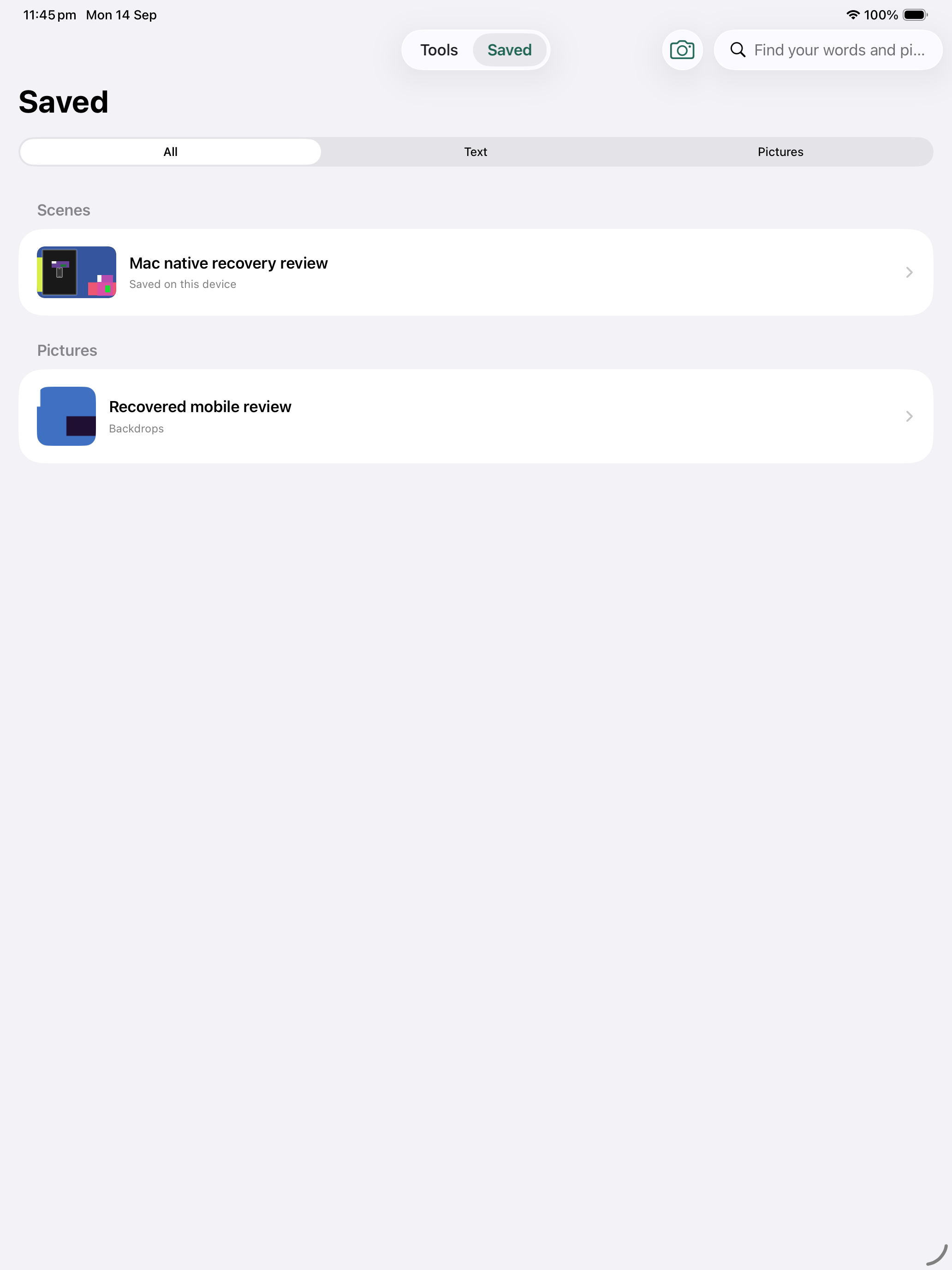
See the actual recovered items on iPadActual native app, synthetic content. The recovered mobile picture and the edited Mac scene remain separate saved items. The test renamed and reopened the recovered picture after relaunch. iPad Pro 13-inch (M5), iOS 26.5 Simulator; source da4f0f4. Cloud and physical-phone transfer were not tested. Capture provenance.
For a useful contribution, verify one disposable scene from creation through transfer, edit and recovery. Report the source revision, exact devices, observed result and remaining gap. An upload receipt, simulator pass or generated image cannot establish the receiving device's result.
 Workbench